
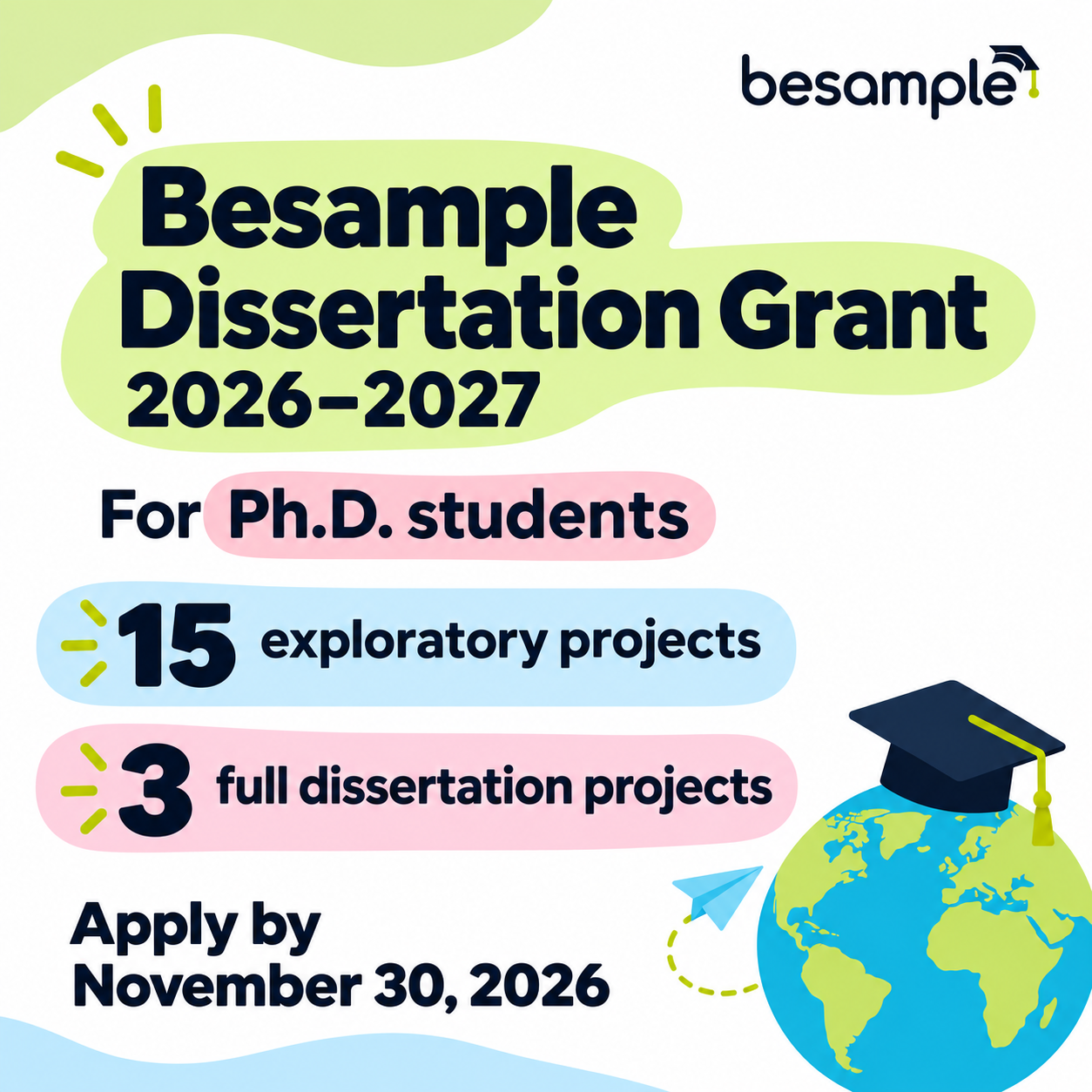
Applications are now open through November 30, 2026, for dissertation-level doctoral researchers worldwide across the social and behavioral sciences. Fifteen researchers will receive exploratory phase funding and join a research accelerator focused on conducting studies beyond the West, with three projects ultimately scaling to up to 3,000 participants.
Besample, a global research platform for conducting studies beyond the West, invites doctoral researchers worldwide to apply to their annual Dissertation Grant with projects where a Western sample alone would be insufficient. The grant aims to support research that tests, challenges, or extends existing knowledge through the study of understudied populations. Eligible fields include psychology, sociology, anthropology, human geography, political science, behavioral science, communication, public health, development studies, and related disciplines.
The program will select 15 Dissertation Grant recipients, each receiving support for an exploratory study with up to 500 participants across multiple countries. Grantees will have access to advanced targeting across demographic, socioeconomic and background characteristics of respondents in chosen countries, allowing them to reach populations relevant to their research questions. The grant is structured as a research accelerator, with workshops and individual support covering cross-cultural study design, localization, ethics, measurement, quality checks, piloting and analysis.
At the end of the program, all grantees will present their research in a public showcase. An academic jury will select three projects to scale into full dissertation studies with up to 2,500 additional participants. For these projects, Besample will support the full-scale implementation of the study, including cultural fit reviews, translations, and longitudinal or experimental designs where relevant.
Last year’s Dissertation Grant cohort brought together PhD researchers from Yale, UCLA, UC Berkeley, Duke, Cornell, UCL, LSE, the University of Pennsylvania and Carnegie Mellon. With access to participants across 16 countries, grantees were able to pursue their research across populations and cultural contexts rarely represented in behavioral science.
Some of the most striking findings challenged assumptions that can seem universal when research stays within Western populations. Samantha Reisman’s research, for example, found that offers typically considered “unfair” in behavioral economics were viewed much more favourably in some cultural contexts. Amanda Royka’s work, meanwhile, revealed striking cross-cultural similarities: across six languages from five language families, people used interjections such as “oh”, “oops” and “wow” for remarkably similar social purposes. Wicia Fang’s cross-country study raised questions about how well established measures travel across cultures, revealing a gap between how researchers conventionally measure social status and what people themselves recognize as signs of status in everyday life.
Together, these findings show what broader sampling can add to behavioral science: not simply more diverse data, but a chance to discover which assumptions travel across cultures — and which do not.
Key dates
- Applications
- October 15–November 30, 2026
- Grantees announced
- January 14, 2027
- Research accelerator
- February–March 2027
- Data collection
- April–July 2027
- Public research showcase
- August 2027